Abrasive Media for Concrete and Stone Surface Prep: Getting the Right Profile Without Substrate Damage
Choosing the wrong blast media for a concrete floor or stone facade doesn't just slow down the job — it can permanently damage the surface, forcing costly repai...
Published
10 Mar 2021
Category
Abrasives
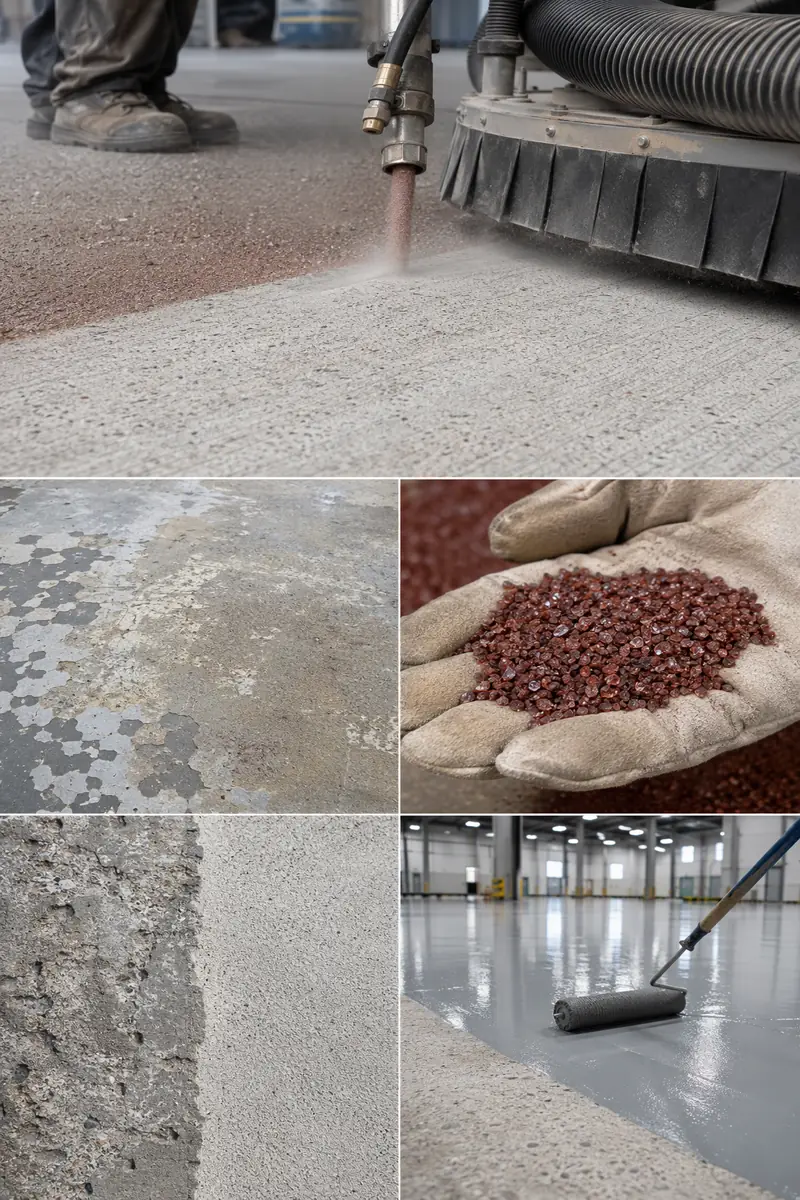
FIG. 01A visual guide to concrete surface prepara...
Editorial collage for an article on abrasive media for concrete. The dominant image shows garnet blasting creating a profile. Supporting panels show unprepared concrete, garnet media, a profile comparison, and a finished coated floor, illustrating the complete surface preparation workflow.
01 Introduction
Choosing the wrong blast media for a concrete floor or stone facade doesn't just slow down the job — it can permanently damage the surface, forcing costly repairs or replacement. For civil and flooring contractors, the goal is a clean, properly prof…
02 Introduction
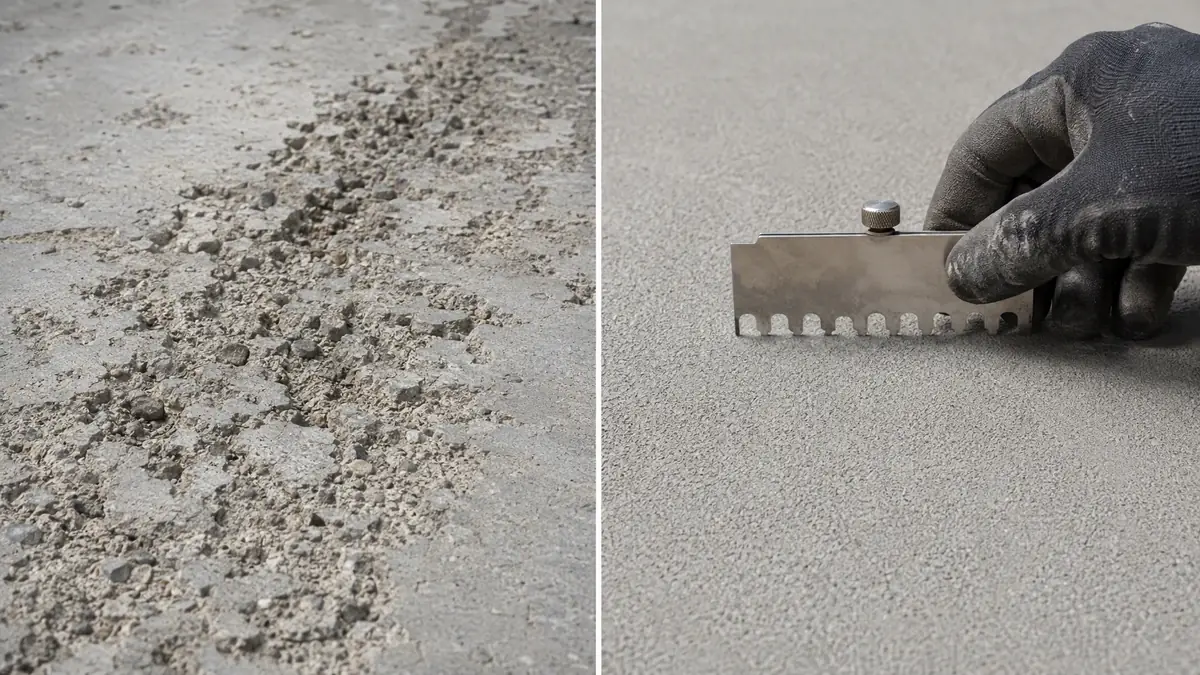
Choosing the wrong blast media can cause irreversible spalling and pitting (left), while the correct media delivers a clean, uniform profile ready for coating (
A comparison image showing the consequences of incorrect versus correct abrasive blasting on concrete. The left side shows a damaged, spalled floor, while the right side shows an ideal surface profile being measured with a comparator gauge, highlighting the importance of media selection.
Concrete and stone are fundamentally different from steel. They are brittle, porous, and sensitive to impact energy. Blast them with the wrong media and you risk spalling, pitting, or closing the surface pores instead of opening them. Yet when done correctly, abrasive blasting is one of the fastest, most controllable ways to remove coatings, laitance, efflorescence, and contaminants from mineral substrates while achieving a specified concrete surface profile (CSP).
This guide is written for contractors and project engineers evaluating blast media for their next concrete or masonry job. It covers which abrasives work, which ones to avoid, how to match media to profile requirements, and practical selection factors that affect cost, speed, and finish quality.
03 What Is Abrasive Blasting on Concrete?
Abrasive blasting propels granular media at high velocity to clean and profile concrete, creating a reliable bond for coatings and overlays.
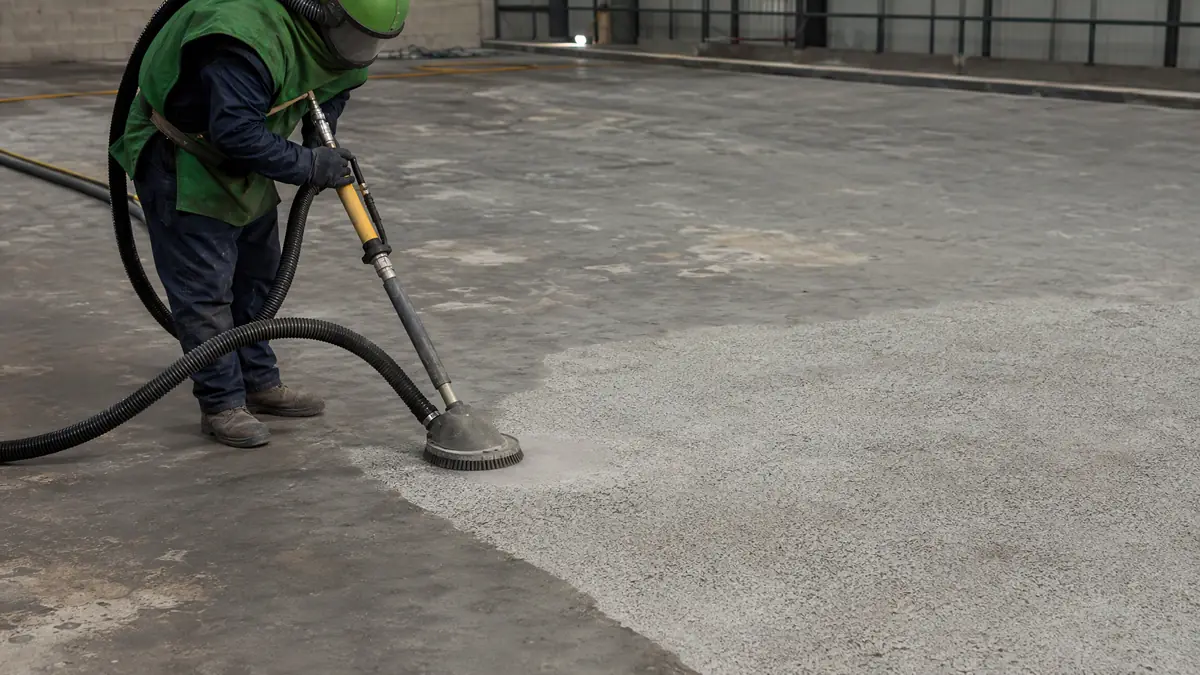
A contractor uses a dustless abrasive blasting system on a concrete floor. The image shows the blast nozzle, garnet media stream, and the clear visual difference between the unprepared and profiled concrete surface, illustrating the cleaning and roughening process.
Abrasive blasting on concrete is the process of propelling granular mineral or synthetic media at high velocity against a concrete or stone surface. The purpose is to clean, roughen, or profile the substrate so that coatings, overlays, waterproofing membranes, or decorative treatments bond reliably.
Unlike blasting steel — where the primary concern is removing rust and mill scale to achieve a cleanliness standard like SA 2.5 — concrete blasting focuses on two outcomes:
Surface cleanliness: Removing dirt, curing compounds, old paint, sealers, efflorescence, and weak surface laitance.
Surface profile: Creating a mechanical key (texture) that the new coating or overlay can grip. This is often measured against the International Concrete Repair Institute (ICRI) Concrete Surface Profile (CSP) scale, typically ranging from CSP 1 (light acid etching equivalent) to CSP 9 (heavy scarification).
04 Why Abrasive Blasting Matters for Mineral Substrates
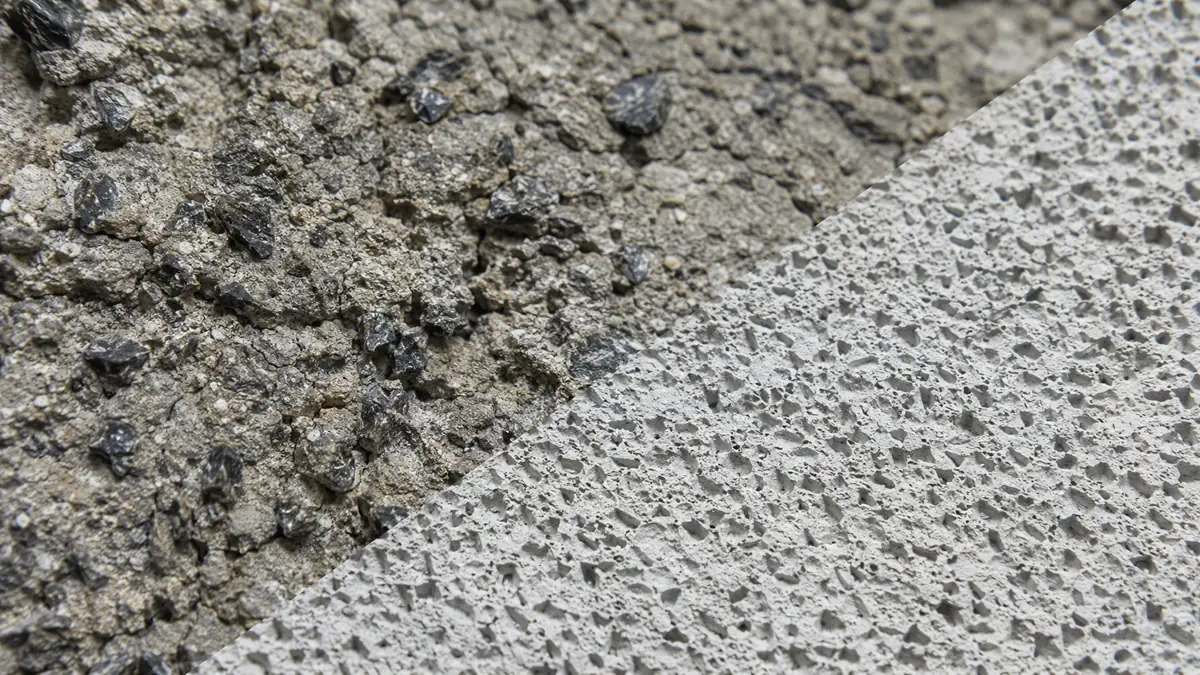
Incorrect media can embed into concrete and close pores (top-left), while the right abrasive opens the surface for optimal coating adhesion (bottom-right).
A detailed macro photograph comparing a failed concrete blasting job with embedded media and closed pores against a successful one with a clean, open, and angular profile. This illustrates the critical concepts of porosity, brittleness, and embedment risk in mineral substrates.
Concrete and stone present unique challenges that make media selection critical:
Porosity: Concrete absorbs water and contaminants. Blasting can open or close surface pores depending on media shape and hardness.
Brittleness: Excessive impact energy causes micro-cracking and spalling, especially on aged or lower-strength concrete.
Dust sensitivity: Some abrasives fracture on impact and create respirable silica or fine dust, raising health and environmental concerns.
Embedment risk: Soft or friable media can embed into the concrete surface, interfering with coating adhesion.
The right abrasive blasting process delivers a uniform profile across the entire surface without these problems — and often in a single pass, making it faster than mechanical methods on large or irregular areas.
05 When to Use Abrasive Blasting vs. Scarifying
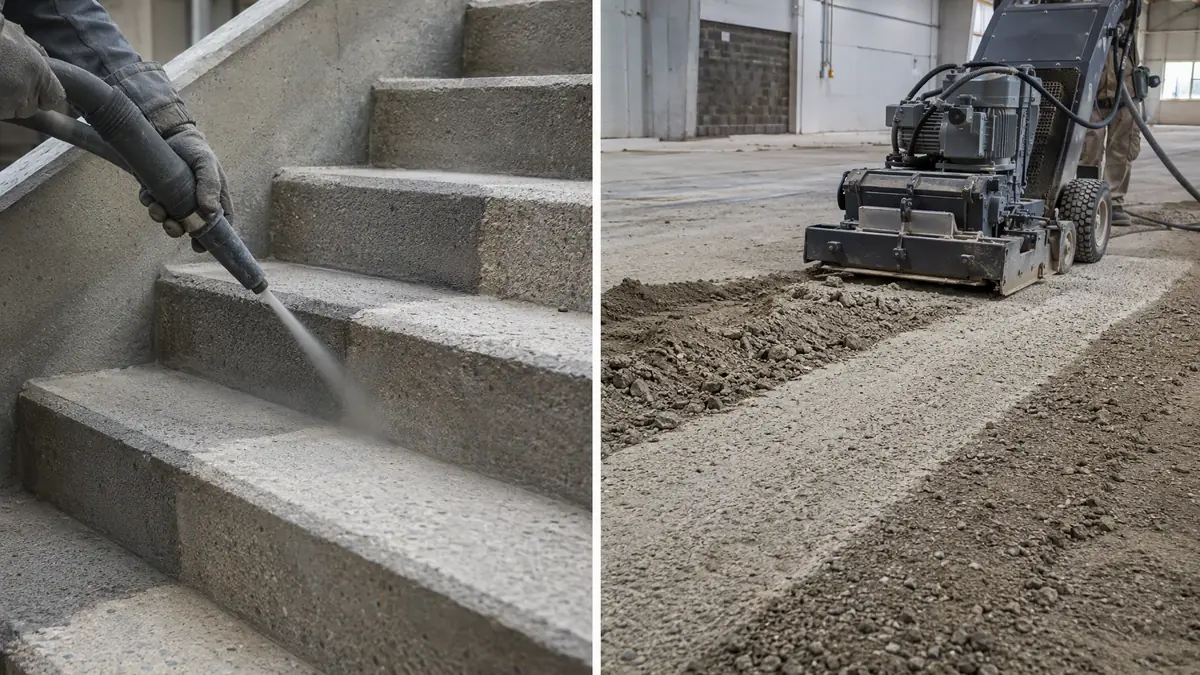
Abrasive blasting excels on complex geometries and for light-to-medium profiles (left), while scarifying is for heavy removal on large, open areas (right).
A visual comparison of two concrete surface preparation methods. The left panel shows abrasive blasting being used on a staircase, highlighting its precision. The right panel shows a scarifier removing a thick layer from a flat floor, demonstrating its use for heavy material removal.
Abrasive blasting and mechanical scarifying are both valid methods for concrete surface preparation, but they serve different purposes.
Choose abrasive blasting when:
The surface has complex geometry, edges, or tight corners where scarifying drums cannot reach.
You need to remove thin coatings, sealers, or contaminants without removing sound concrete.
A uniform, light-to-medium profile (CSP 2 to CSP 5) is specified.
The substrate is stone, brick, or decorative masonry where impact tools would cause visible damage.
Heavy concrete removal (several millimetres) is required.
The surface is flat and large, with no obstructions.
A very aggressive profile (CSP 6 to CSP 9) is specified.
High production speed on horizontal slabs is the priority.
In practice, many flooring contractors use abrasive blasting as a scarifying alternative for vertical surfaces, overhead work, and areas where precision matters more than raw removal rate.
06 Types of Abrasive Media for Concrete and Stone
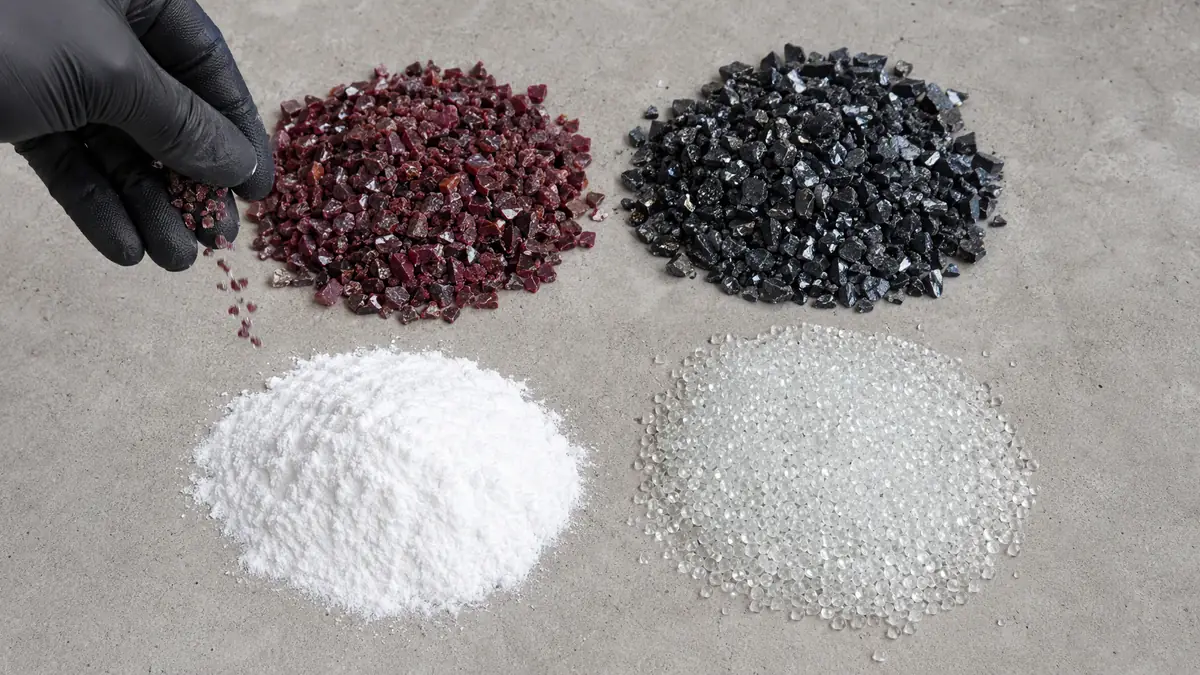
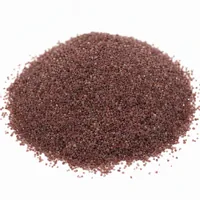
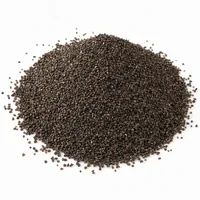
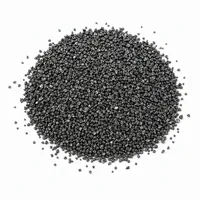
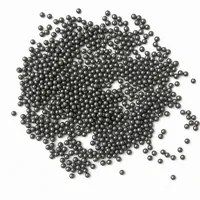
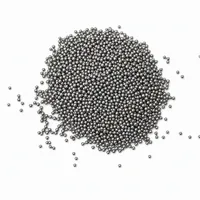
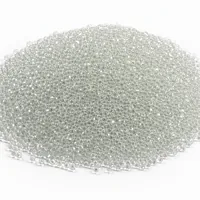
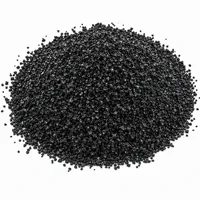
Common mineral and synthetic abrasives for concrete: angular garnet, glassy coal slag, fine baking soda, and rounded glass beads.
A product-style photograph showcasing four different types of abrasive media used for concrete and stone surface preparation. The image clearly shows the distinct color, shape, and texture of garnet, coal slag, baking soda, and glass beads, aiding in material identification.
Mineral and synthetic abrasives dominate concrete blasting because metallic abrasives (steel grit, steel shot) are rarely suitable — they can embed, rust-stain the surface, and are difficult to contain on open job sites.
Garnet
Garnet is a naturally hard, angular mineral abrasive widely used for concrete and stone blasting.
Hardness: 7.5–8.0 Mohs, which is sufficient to cut concrete without excessive fracturing.
Characteristics: Produces sharp, angular particles that create a clean, uniform profile. Low dust generation compared to slag abrasives. Garnet is inert and does not contaminate the substrate.
Typical applications: Removing paint and thin coatings from concrete; profiling before epoxy or polyurethane application; cleaning brick and stone facades.
Limitations: Higher cost per kilogram than coal slag or crushed glass. Not aggressive enough for heavy concrete removal.
Profile range: Typically achieves CSP 2 to CSP 5 depending on grit size and blasting pressure.
Aluminum Oxide
Aluminum oxide is a tough, blocky synthetic abrasive with high hardness and excellent recyclability.
Hardness: 9.0 Mohs, second only to diamond and silicon carbide among common abrasives.
Characteristics: Cuts aggressively and fractures slowly, making it suitable for multiple reuse cycles in contained blasting setups. Available in a wide range of grit sizes.
Typical applications: Heavy coating removal on concrete floors; profiling dense, high-strength concrete; etching stone for decorative finishes.
Limitations: Higher upfront cost. Requires proper dust collection. Can be overly aggressive on soft or aged concrete if grit size is not matched to the substrate.
Profile range: Can achieve CSP 3 to CSP 7 with appropriate grit selection and pressure control.
Crushed glass is an angular, recycled abrasive gaining popularity for concrete preparation.
Hardness: 5.5–6.0 Mohs, softer than garnet but still effective on concrete.
Characteristics: Produces a bright, clean surface. Lower dust than slag. Non-toxic and environmentally friendly. Particles are angular but less durable — they fracture on impact, which limits reusability.
Typical applications: Light coating removal; cleaning concrete and masonry; preparing surfaces for thin-film coatings and sealers.
Limitations: Single-use in most field applications. Less effective on thick, hard coatings. Profile depth is limited compared to garnet or aluminum oxide.
Profile range: Typically CSP 2 to CSP 4.
Coal Slag / Copper Slag
Slag abrasives are widely available and low-cost, but they come with important caveats for concrete work.
Hardness: 6.0–7.0 Mohs.
Characteristics: Angular, fast-cutting, and inexpensive. High dust generation. May contain heavy metal residues depending on the source.
Typical applications: Heavy coating removal where cost is the primary driver; large-area blasting on industrial floors.
Limitations: High friability creates significant dust. Potential for surface contamination. Many specifications prohibit slag on concrete where coating adhesion is critical. Requires thorough post-blast cleaning.
Profile range: CSP 3 to CSP 6, but surface cleanliness and embedment risk must be verified.
Walnut Shell / Corn Cob (Organic Media)
These soft, organic abrasives are used for delicate stone and masonry cleaning, not for profiling.
Hardness: 3.0–4.0 Mohs.
Characteristics: Non-damaging to soft stone, historic masonry, and decorative surfaces. Removes dirt, soot, and light coatings without altering the substrate profile.
Typical applications: Cleaning historic brickwork, limestone, marble, and terracotta; removing graffiti from stone.
Limitations: No profiling capability. Not suitable for coating removal on concrete. Slow cutting speed.
Profile range: Does not create a profile — used when the existing surface texture must be preserved.
Media to Avoid on Concrete
Some abrasives are fundamentally unsuitable for mineral substrates:
Steel grit / steel shot: Embeds into concrete, rusts, and causes staining. Difficult to recover from open sites. Only used in enclosed shot blasting machines with dedicated recovery systems.
Silica sand: Creates respirable crystalline silica dust — a serious health hazard. Banned or heavily restricted in most jurisdictions for dry blasting.
Silicon carbide: Extremely hard and aggressive. Overkill for concrete and prohibitively expensive for general surface preparation. Reserved for specialised etching or cutting applications.
07 How to Select the Right Abrasive for a Concrete Profile
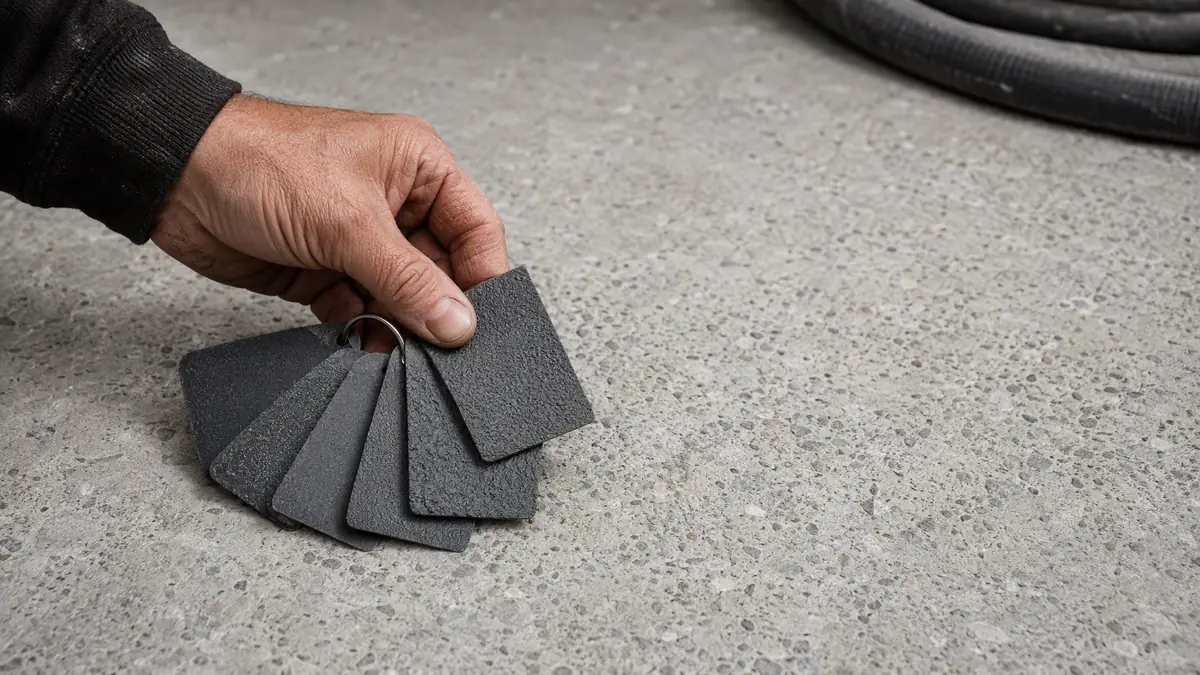
Matching the blasted surface texture to an ICRI CSP comparator ensures the profile meets the coating manufacturer's specifications.
A close-up image showing the process of verifying a concrete surface profile after abrasive blasting. A contractor uses ICRI CSP molded rubber comparators to match the achieved texture against the specified standard, a critical step in quality control for coating adhesion.
Matching media to the required profile is a systematic process. Use these decision factors:
1. Know the Specified Profile
The coating or overlay manufacturer typically specifies a CSP range. For example:
Thin-film sealers and stains: CSP 1 to CSP 2
Epoxy and polyurethane coatings (0.2–0.5 mm): CSP 3 to CSP 5
Polymer-modified cementitious overlays: CSP 4 to CSP 6
Thick self-levelling underlayments: CSP 5 to CSP 7
Confirm the CSP requirement before selecting media. Blasting with media that is too fine will not achieve the specified profile; media that is too coarse may exceed it and damage the substrate.
2. Assess the Substrate Condition
Concrete compressive strength: Lower-strength concrete (below 20 MPa) is more prone to spalling. Use softer or finer media and lower blasting pressure.
Age and surface condition: Aged, weathered concrete may have a weak surface layer (laitance) that must be removed. New concrete may still be curing and more sensitive to impact.
Existing coatings: Thick epoxy or polyurethane coatings require more aggressive media. Thin sealers or curing compounds can often be removed with garnet or crushed glass.
3. Match Media Hardness to the Task
A general guideline for concrete blasting:
Substrate Condition
Recommended Media Hardness
Suitable Abrasives
Soft/aged concrete, light cleaning
Low to medium
Crushed glass, fine garnet
Sound concrete, coating removal
Medium to high
Garnet, aluminum oxide
Dense/high-strength concrete, heavy removal
High
Coarse aluminum oxide
Stone, brick, decorative masonry
Low to medium
Fine garnet, walnut shell (cleaning only)
4. Consider Job Site Constraints
Containment: Open sites with limited containment favour low-dust media (garnet, crushed glass). Slag abrasives generate more airborne dust.
Recovery and disposal: Single-use media like crushed glass and slag require disposal planning. Recyclable media like aluminum oxide need recovery equipment.
Wet vs. dry blasting: Wet blasting suppresses dust but may introduce water into the concrete, affecting coating application timing. Confirm compatibility with the coating system.
Environmental regulations: Some jurisdictions restrict certain abrasives. Verify local requirements for dust emissions and waste disposal.
5. Test Before Full Production
Always blast a test area before committing to full production. Evaluate:
Is the profile uniform across the test area?
Does the profile match the CSP comparator or replicate the specified texture?
Is there any visible spalling, micro-cracking, or embedded media?
Does the surface clean up adequately before coating?
A test patch costs a small amount of time and material but prevents expensive rework.
08 Common Mistakes When Blasting Concrete
Using Media That Is Too Hard or Too Coarse
The most frequent error is selecting an abrasive based on what works on steel. Concrete cannot absorb the same impact energy. Overly aggressive media causes spalling, exposes aggregate unnecessarily, and creates a profile that is too deep for the specified coating — leading to poor coverage and premature coating failure.
Prevention: Start with a medium-grade garnet (30/60 or 36 mesh) and adjust upward only if the profile is insufficient.
Neglecting Post-Blast Cleaning
Blasted concrete holds dust and fine abrasive particles in its pores. If these are not removed before coating, adhesion suffers. Vacuuming alone is often insufficient — follow with compressed air blowing or pressure washing (with adequate drying time) as recommended by the coating manufacturer.
Blasting Wet or Uncured Concrete
Concrete that has not fully cured or that contains excess moisture can spall more easily under blasting. Moisture also affects coating adhesion. Verify substrate moisture content against the coating specification before blasting.
Ignoring Edge and Corner Sensitivity
Concrete edges, corners, and control joints are more vulnerable to impact damage. Reduce dwell time in these areas, use a wider nozzle angle, or switch to a finer grit for edge work.
09 Evaluating Blasting Results on Concrete
After blasting, verify the outcome against three criteria:
Visual cleanliness: The surface should be free of laitance, coatings, oil stains, and visible contaminants. For reference, a surface equivalent to ICRI CSP 3–5 should show fine aggregate exposure with no loose material.
Profile depth and texture: Compare the blasted surface against ICRI CSP molded rubber comparators or test with replica tape if a numerical value is required. The texture should be uniform across the entire area.
Surface soundness: Tap-test or scratch-test suspect areas. There should be no hollow spots, delamination, or easily dislodged aggregate.
If the profile is insufficient, a second pass with the same media or a slightly coarser grit may be needed. If the profile is too aggressive, the surface may require light grinding or a skim coat before coating — an expensive correction that underscores the value of test blasting.
10 Conclusion
Abrasive blasting on concrete and stone is a precise process that demands the right media for the substrate. Mineral abrasives — particularly garnet and aluminum oxide — offer the best balance of cutting speed, profile control, and surface cleanliness for most civil and flooring applications. Crushed glass provides a cost-effective alternative for lighter work, while slag abrasives should be used cautiously and only where embedment and dust are not critical concerns.
The key to success is matching media hardness, grit size, and blasting parameters to the specified concrete profile and the actual substrate condition. A test patch is not optional — it is the cheapest insurance against a failed coating job.
11 Frequently Asked Questions
How do I know which abrasive media is right for my concrete profile specification?
Start by confirming the ICRI Concrete Surface Profile (CSP) range required by your coating or overlay manufacturer. For thin sealers (CSP 1-2), use fine crushed glass or low-pressure fine garnet. For epoxy coatings (CSP 3-5), garnet or aluminum oxide are standard. For thick overlays (CSP 5-7), select a coarser grit of aluminum oxide. Always test a small, inconspicuous area first to verify the profile before proceeding with the full job.
Can I use the same blast media on stone and concrete?
It depends on the stone's hardness and the desired finish. Hard, angular media like garnet or aluminum oxide can etch or damage softer stones like limestone or marble. For cleaning historic masonry or delicate stone facades without altering the profile, use a soft organic media like walnut shell. For hard granite or bluestone, garnet is often suitable for achieving a light profile.
Why is steel shot or grit not recommended for open concrete blasting?
Steel abrasives embed into the porous concrete surface, where they will eventually rust, causing unsightly stains and potentially compromising the bond of any applied coating. They are also extremely difficult to contain and recover on open job sites, creating a hazardous slip condition. Steel shot is only suitable for use in enclosed, self-contained shot blasting machines with magnetic recovery systems.
What is the biggest mistake contractors make when blasting concrete?
The most common mistake is selecting an abrasive that is too aggressive for the substrate's compressive strength, leading to spalling, micro-cracking, and an over-profiled surface. This often happens when using a coarse aluminum oxide or high-pressure slag on aged or low-strength concrete. Another critical error is failing to properly clean the surface after blasting, leaving dust or embedded particles that cause coating adhesion failure.
Is coal slag a safe and effective abrasive for concrete?
Coal slag is effective for fast, heavy coating removal but comes with significant drawbacks. It generates high levels of dust, may contain heavy metal residues that can contaminate the substrate, and its friable particles can embed into the concrete. Many coating specifications prohibit slag use due to adhesion risks. If you use it, thorough post-blast vacuuming and washing are mandatory.
When should I choose abrasive blasting over mechanical scarifying?
Choose abrasive blasting when working on vertical, overhead, or geometrically complex surfaces where scarifying drums cannot reach. It is the better choice for removing thin coatings or laitance without removing sound concrete, and for achieving a uniform, light-to-medium profile (CSP 2-5) on decorative masonry or stone where impact tools would cause visible damage.
What safety and dust control measures are essential for concrete blasting?
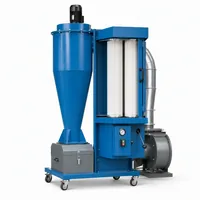
Never use silica sand, as it creates respirable crystalline silica dust, a serious health hazard. Even with safer media, use dustless or wet blasting methods where possible, and ensure all operators wear properly fitted, NIOSH-approved respiratory protection. Full containment with negative air pressure or high-efficiency dust collectors is critical on occupied or environmentally sensitive sites.
How do I compare abrasive media options for my next project?
The most practical next step is to compare the cost, profile range, and consumption rate of suitable abrasives like garnet, aluminum oxide, and crushed glass. You can review and compare relevant abrasive products on SPA2Z and submit an enquiry to check availability and get a quote for your specific project requirements.
12 Solution
Selecting the right abrasive for your concrete or stone project starts with understanding your profile requirement and job site conditions. Compare mineral abrasive options — garnet, aluminum oxide, crushed glass, and more — on SPA2Z to evaluate grit sizes, packaging, and availability for your location. For technical guidance on media compatibility with your specific substrate or coating system, contact the SPA2Z sales team with your project details.
13 Get a quote
Get a quote
Tell us what you need. We reply within one business day.
Recommended products
Catalogue products matched to this article. Ask for grade, quantity and destination.