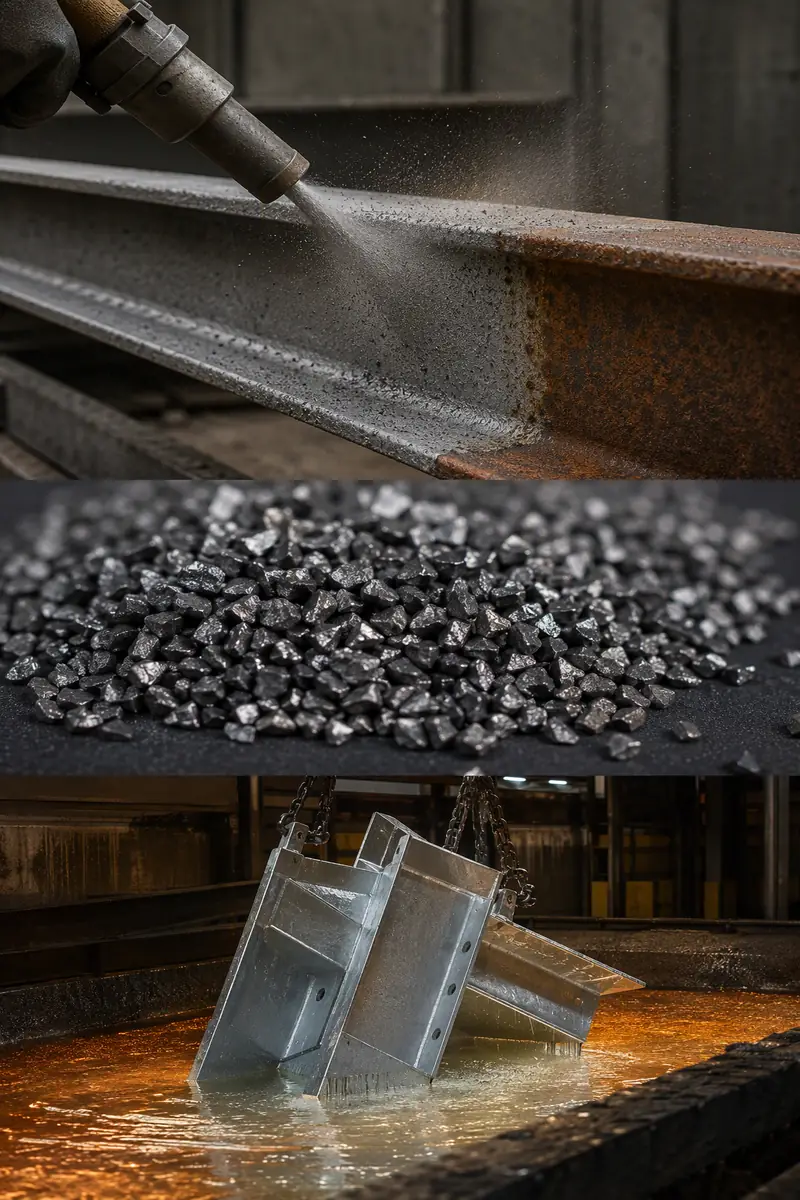
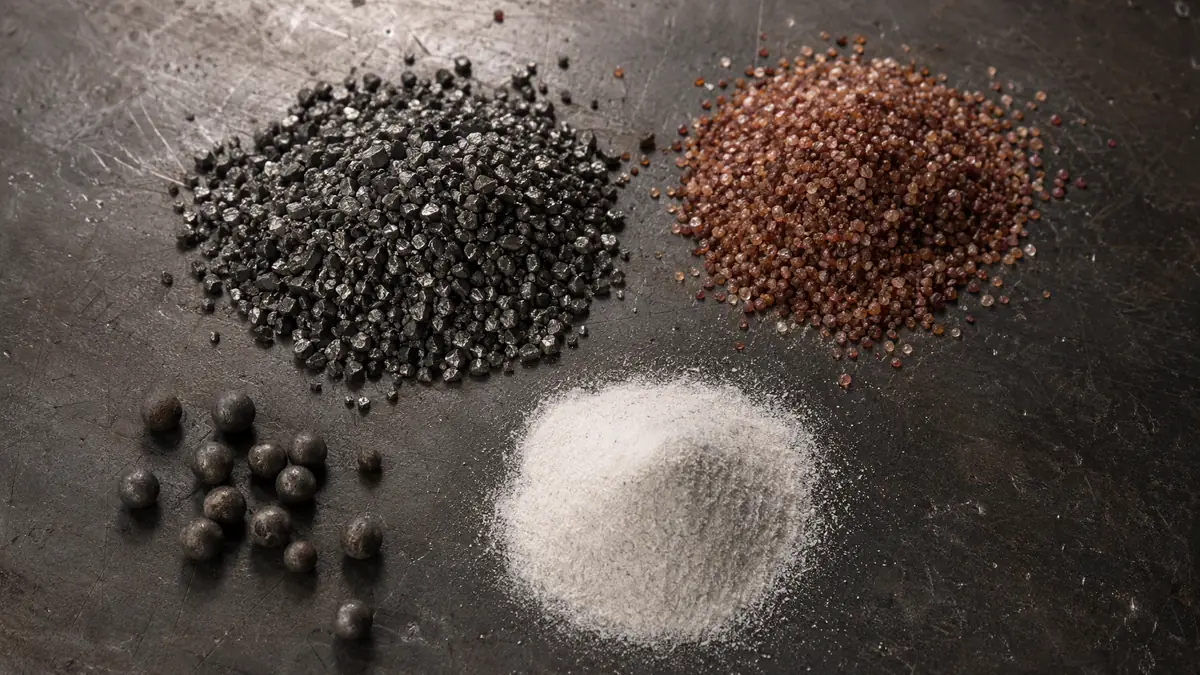
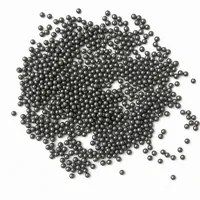
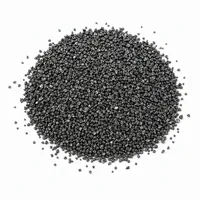
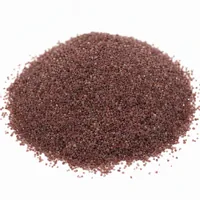
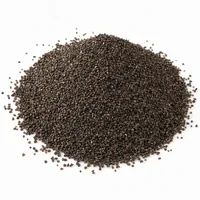
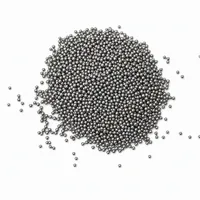
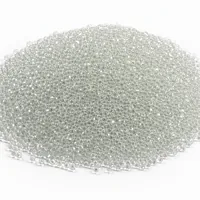
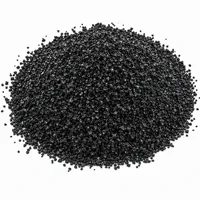
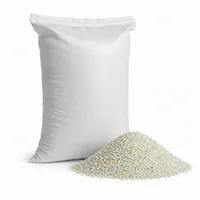
An industrial flat-lay photograph comparing different abrasive media types used for surface preparation. The image clearly shows the angularity of steel grit, the crystalline structure of garnet, and the fine powder of aluminum oxide, with worn spherical shot providing a contrast.

Steel Grit
Steel grit is the most widely used abrasive in galvanizing plants operating wheel-blast machines. Its angular particles cut aggressively through mill scale and produce a sharp, consistent profile.
Advantages: High recyclability (often hundreds of cycles in a properly maintained blast machine), excellent cleaning rate on heavy mill scale, and consistent profile generation. Steel grit leaves minimal embedment when operated at correct hardness relative to the substrate.
Limitations: Initial cost is higher than expendable minerals. Requires a working mix of grit sizes to maintain profile consistency over time. Steel grit that is too hard or operated at excessive velocity can cause work hardening of the steel surface or excessive profile depth.
Typical selection: Grit sizes in the G40 to G50 range (per SAE J444) are common for structural steel destined for galvanizing, producing profiles in the 50–75 micron range. Confirm against your galvanizer's specification.
Steel Shot
Steel shot is spherical rather than angular. It is rarely used alone for galvanizing preparation because it peens the surface rather than cutting it, leaving mill scale intact in depressions.
Where it appears: Shot is sometimes blended with grit in wheel-blast machines to control profile and improve coverage on complex geometries. A typical working mix might contain 20–30% shot by volume, but the exact ratio depends on the steel grade, initial surface condition, and galvanizer requirements.
Caution: Excessive shot content in the working mix will reduce cleaning effectiveness on mill scale. Monitor the mix regularly using sieve analysis.
Garnet
Garnet is a natural mineral abrasive used primarily in open-nozzle blasting operations where wheel-blast equipment is unavailable or impractical — for example, on large fabrications, field repairs, or touch-up work.
Advantages: Produces a clean, angular profile with low dust generation compared to other mineral abrasives. Garnet is inert and leaves no chemical residue that would interfere with flux chemistry or zinc adhesion. It is also silica-free, eliminating the silicosis hazard associated with sand blasting.
Limitations: Garnet is an expendable abrasive with limited recyclability — typically one to three cycles at most before particle breakdown renders it ineffective. Consumption rates and disposal costs must be factored into job costing.
Typical selection: 30/60 or 20/40 mesh garnet commonly produces profiles in the 50–75 micron range suitable for galvanizing. Finer grades (80 mesh) may be appropriate for thinner sections where a lighter profile is specified.
Aluminum Oxide
Aluminum oxide is a hard, angular synthetic abrasive occasionally specified for galvanizing preparation on high-strength or alloy steels where ferrous contamination from steel grit is a concern.
Advantages: Extremely hard (Mohs 9), fast cutting, and non-ferrous — eliminating any risk of rust bloom from embedded particles before galvanizing. Available in tightly graded sizes for precise profile control.
Limitations: Higher cost than steel grit or garnet. Lower impact resistance means it fractures more readily in wheel-blast machines, limiting recyclability compared to metallic media. Generally reserved for specialized applications rather than high-volume structural steel preparation.
Media to Avoid or Use with Caution
Copper slag and coal slag: These expendable abrasives are common in open blasting but can leave residues that interfere with flux effectiveness. Some galvanizers prohibit their use entirely. Verify acceptability with your galvanizer before specifying.
Silica sand: Prohibited in most jurisdictions due to the silicosis hazard. Even where permitted, silica sand produces excessive dust and inconsistent profiles. It has no place in a professional galvanizing preparation operation.
Walnut shell, plastic media, and other soft abrasives: These are designed for paint stripping and delicate substrates. They cannot remove mill scale effectively and will not achieve the Sa 2½ cleanliness required for HDG.