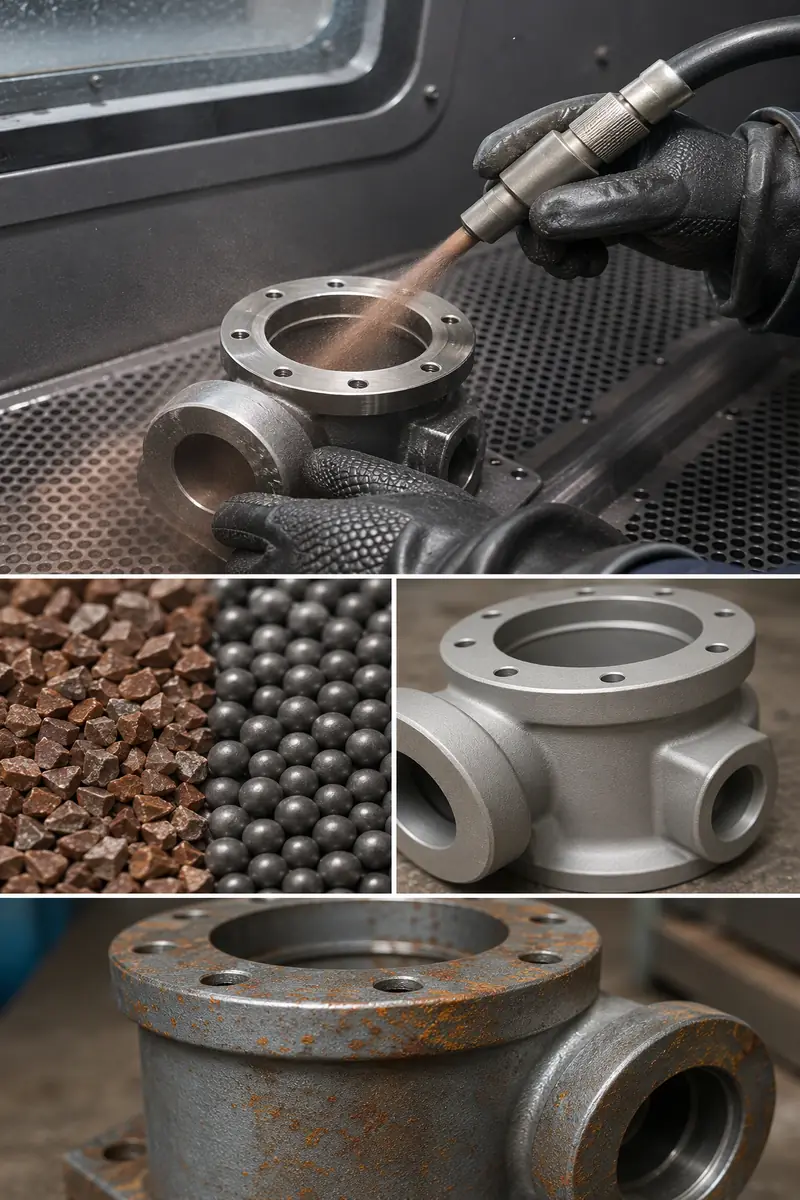
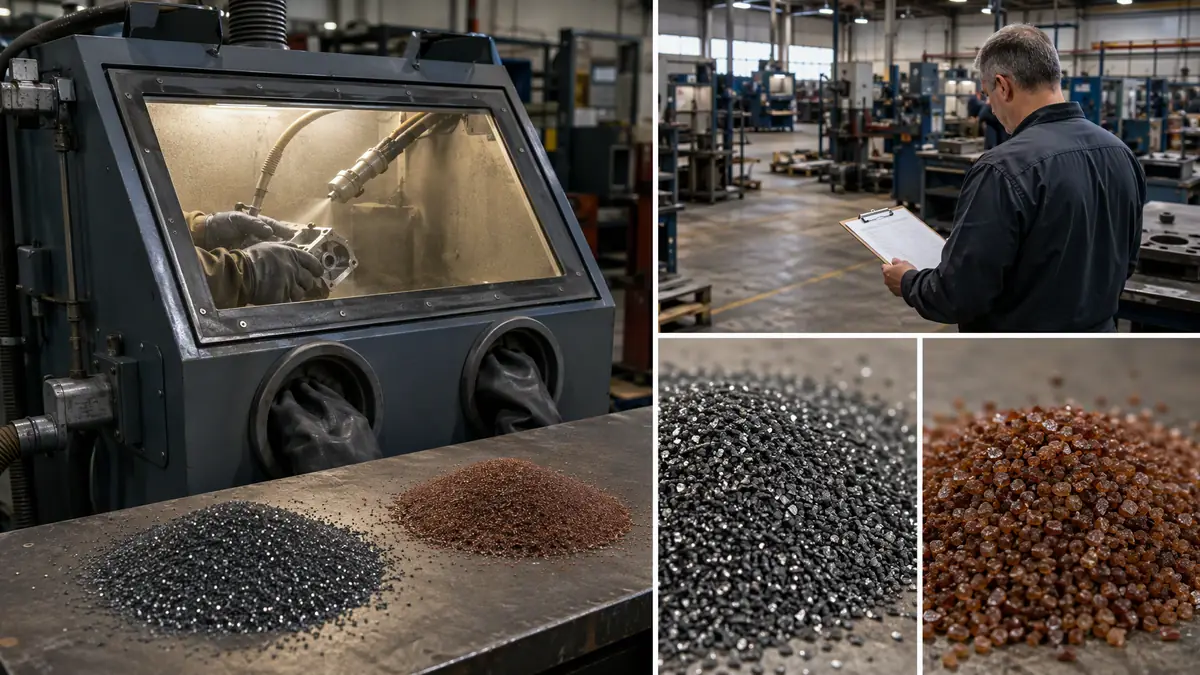
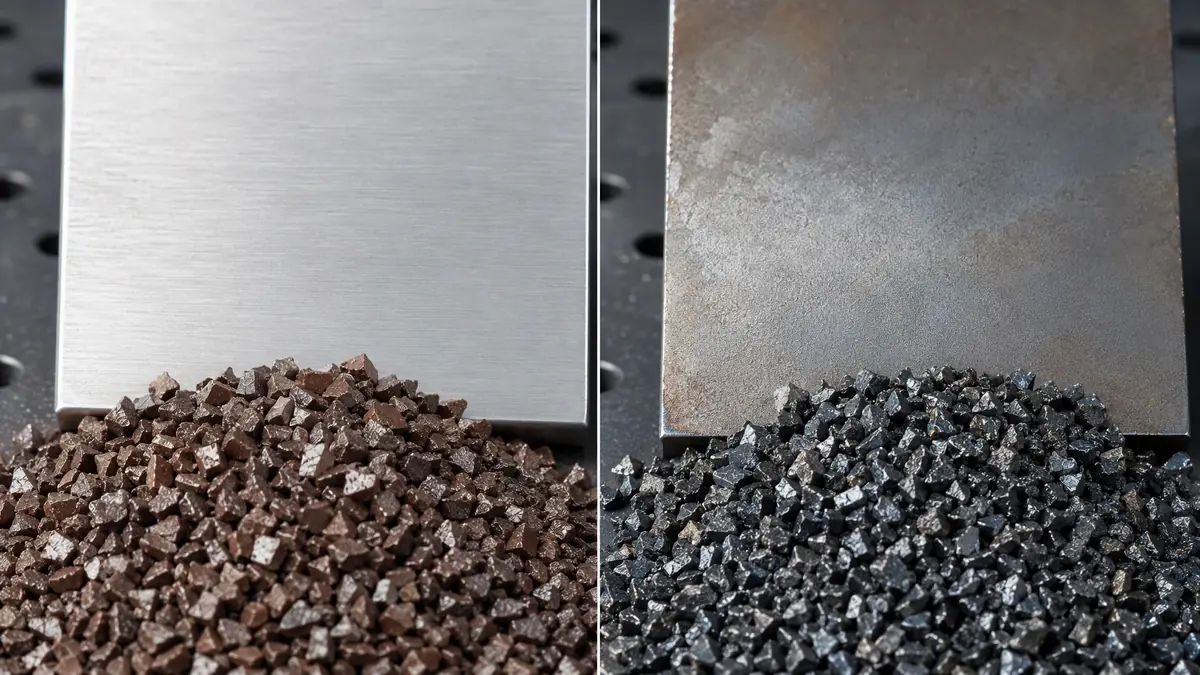
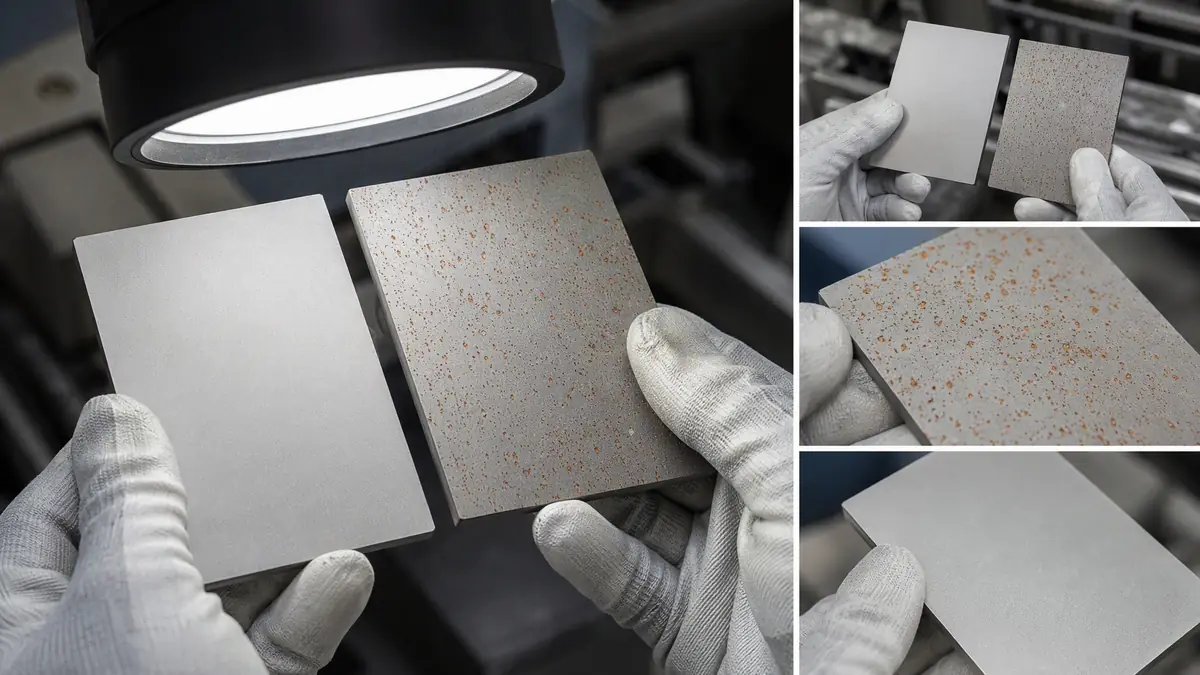
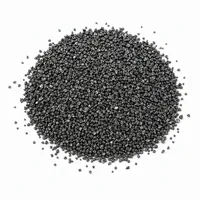
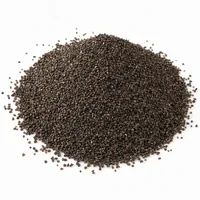
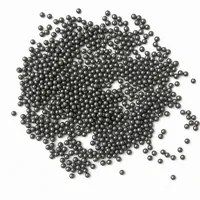
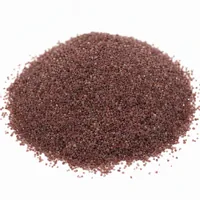
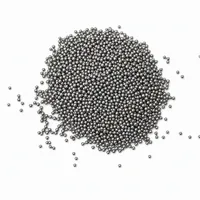
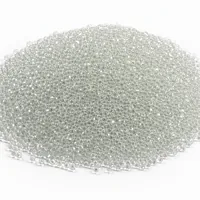
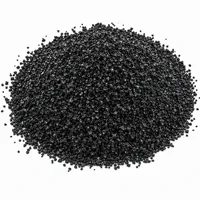
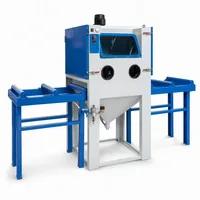
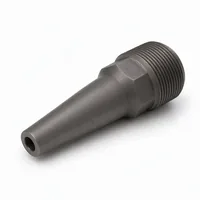
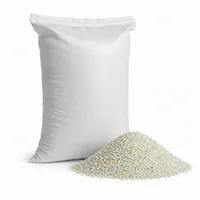
A detailed split-screen image comparing abrasive media. The left side shows sharp aluminum oxide particles and a clean stainless steel finish. The right side shows steel grit particles and a carbon steel finish with slight discoloration, visually representing the contamination risk.

Aluminum Oxide in Cabinet Service
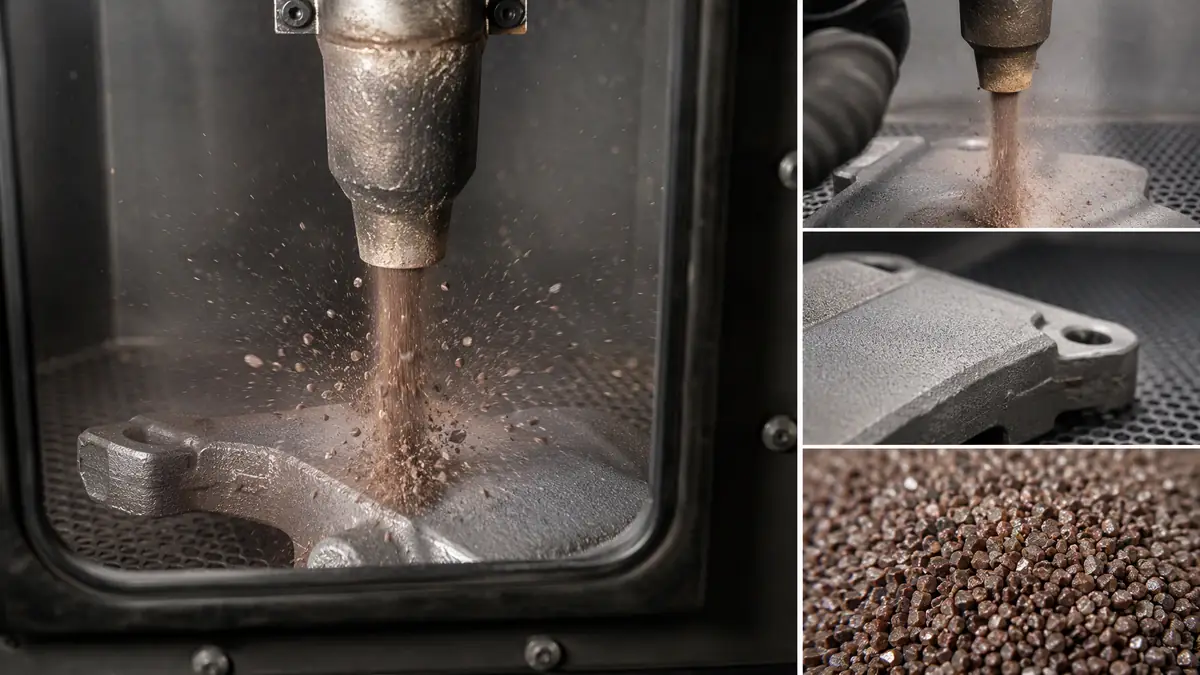
Aluminum oxide (Al₂O₃) is a synthetic, angular mineral abrasive with a Mohs hardness of 9. In cabinet use, it fractures along crystalline planes, exposing fresh sharp edges rather than rounding over. This self-sharpening characteristic means it cuts consistently through its useful life.
Cabinet advantages of alumina:
- No ferrous contamination. Alumina leaves no free iron on the workpiece surface. For stainless steel, aluminum, and non-ferrous alloys, this eliminates flash rusting and pitting corrosion that steel media can cause — a critical requirement in food-grade, medical, and marine applications.
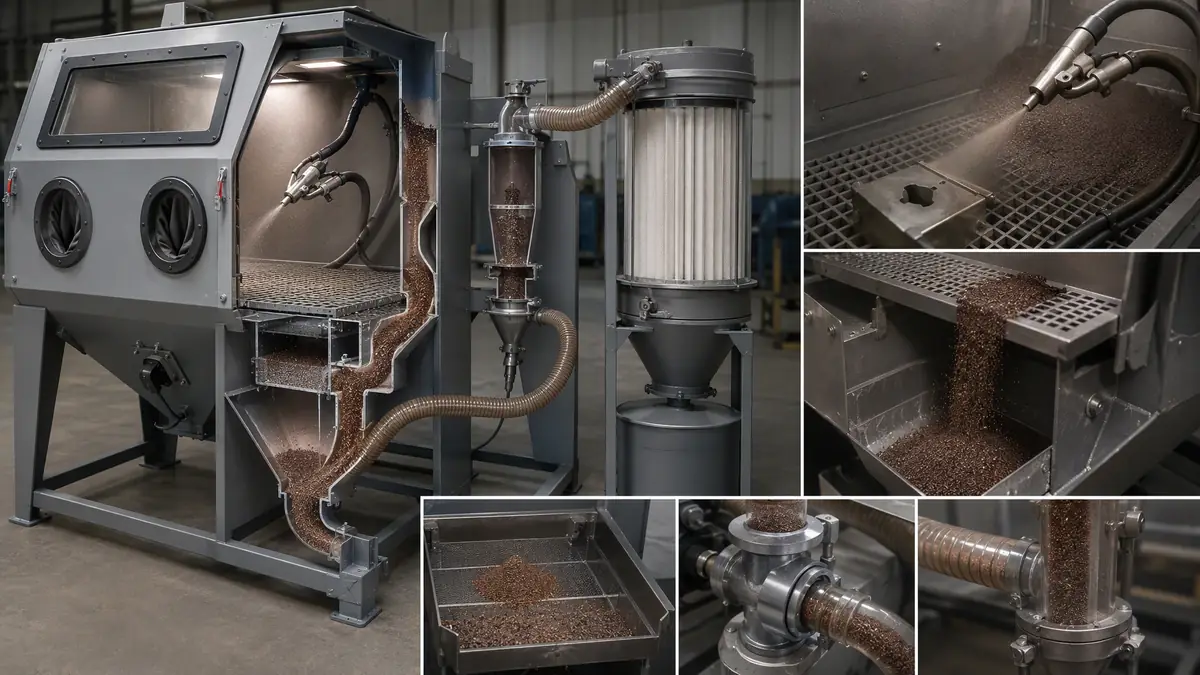
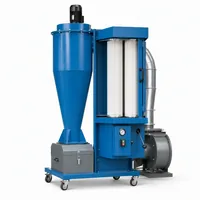
- Predictable dust profile. As alumina breaks down, it produces fine mineral dust that standard cartridge dust collectors handle effectively. The dust is inert and non-sparking.
- Consistent feed. Angular alumina flows reliably through cabinet metering valves and does not bridge as readily as irregular steel grit.
- Surface profile control. Alumina produces a sharp, angular anchor profile suited to paint and coating adhesion on most metals.
Cabinet limitations of alumina:
- Higher initial cost per kilogram compared to steel grit
- Shorter recycle life than steel grit in aggressive, high-impact blasting
- Generates more dust volume as it fractures, increasing dust collector loading
- Not ideal for heavy mill scale removal where impact energy matters more than sharpness
Steel Grit in Cabinet Service
Steel grit is crushed angular steel, typically with a hardness of 40–65 HRC depending on grade (GP, GL, GH). It is dense, tough, and designed for high-impact cleaning.
Cabinet advantages of steel grit:
- Longer recycle life. Steel grit resists fracture better than mineral abrasives. In a well-maintained cabinet, it can cycle many more times than alumina before breaking down, reducing media consumption.
- Lower cost per cycle (in the right application). When blasting hard ferrous parts where contamination is acceptable, steel grit's durability can deliver lower media cost per part.
- High impact energy. The density of steel (approximately 7.8 g/cm³ vs alumina's 3.9 g/cm³) delivers more kinetic energy per particle, making it effective for heavy rust and scale removal.
Cabinet limitations of steel grit:
- Ferrous contamination is unavoidable. Steel grit fractures and wears, depositing microscopic iron particles on the workpiece. On carbon steel parts that will be immediately coated, this may be acceptable. On stainless steel, aluminum, or parts stored before coating, it causes corrosion and coating adhesion failures.
- Hopper and screen problems. Steel grit is heavy. It can compact in hoppers, bridge across screen openings, and accelerate wear on cabinet internals — particularly metering valves, hose linings, and nozzle holders.
- Dust collector challenges. Steel dust is conductive and can short out pulse-jet cleaning systems not designed for metallic fines. Some dust collector filter media are incompatible with ferrous dust loading.
- Rusting in the cabinet. If moisture enters the cabinet air supply, steel grit rusts. Rusted grit clumps, clogs screens, and produces inconsistent blasting. Alumina is inert and unaffected by moisture.
- Spark hazard. Steel grit impacting steel workpieces can generate sparks. In cabinets used with flammable coatings or solvents, this is a safety concern.